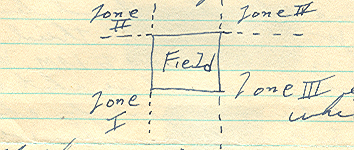
Well last night and this morning I had my first night flying experience. First I'll tell you how it works. There are 16 of us flying at once in four zones and each zone has four levels like this.
The first level is at 2,000 ft. and then every 1,000 ft. up to 5,000 ft which makes four levels. Well they assign you your zone no. and level and then you take off and climb up to your zone and circle at your altitude until they call you in. They start with the lower level of one zone and work up to the top. They call the lower zone - wait until he answers - then call the next zone and so forth. So there are four planes coming into the field at once. Before you can enter the traffic pattern you have to get down to 1500 ft. in your zone, so naturally the low man will get there first and so on. Well if you're at 5,000 feet you have to get down in about three minutes which makes a 1000 ft per min seem slow. The only way to get down on time is to point the nose to the ground and let her go. Well you come in after peeling off and land and then you taxi back and take off and go to your zone again. This procedure goes on for two hours straight and then you can go home. The runways are lined with yellow smudge pots while the beginning of the runway is lighted by floodlights. You set her down into the lights and then roll her off into the darker part of the runway. The whole trick in night flying is keeping a horizon. If you can't see a horizon - a line of lights - two lights - a town - or the actual horizon - you don't know what attitude your plane is in. So when you fly at night you use your instruments as little as possible. The only ones you use are your air speed - to check if you're stalling out - and your altimeter - to see if you're gaining or losing altitude. As far as landing the plane goes it's just as easy as in the day time - it's straight and level flight that's hard.
Well I had the third period to fly in which is from 11 PM to 1 AM. Well my instructor took me up and we shot six landings and then circled in our zone for about 20 minutes. Altogether it took a hour. Then we came down and I went up solo, shot three landings and then circled in my zone for about 40 minutes. That was my total dual instruction for night flying - I don't get any more - the rest is all solo. When you fly at night you have to keep the canopy open all the time, so it gets quite cold. I'll admit I wasn't very confident when he got out of the plane but after the first landing everything was OK. Boy, it sure is fun, I can hardly wait until we go on our night cross country up to Fresno and back. I went on my second cross country today - to Coalinga, Porterville, Cuyama and back - it only took 2 and one half hours. I had a little trouble finding Porterville, but I finally figured out where it was and landed there OK. I sure do like to land at strange fields - I don't know why but it makes you feel more confident in yourself.
Now, for your questions. As for the "Snort Shorters" which I am a member you have to be a pilot - that is the only qualification. How it originated or started from I don't know but there's is no drinking to it. Pa asked about formation flying. We get 4 hours - 2 dual - 2 solo - so far I've had one dual, the solo rides are with a instructor as lead man and two wing men are solo students. I got a card and paper from Mae and I sent her a long letter. It's about time Connie got my letter, I sent it years ago. Well that's all for tonight, so I'll sign off.
Love,
Rae